We use cookies to improve your experience and keep DungeonFog running smoothly. Accept all cookies or customize your choices. Details are in our Privacy Policy.
(Still no real cookies, sadly.)
Together with WorldAnvil we challenge you to write a One-Shot RPG adventure!
Your world is full of infinite adventures just waiting to be written; characters to save, treasures to discover, injustices to right! Take part in the World Anvil Community Challenge and create a short, one-shot RPG adventure from one of these quests. And of course, we here at DungeonFog challenge you to create at least one - or many! - stunning new battlemaps for this new adventure.
Your adventure can be in any genre or setting, with any sort of objectives or locales. It can also be in any RPG system you choose! Your map(s) need to work for a single one-shot adventure and guide players through the entire story you want to tell. Whether you use one map or several is up to you, but make sure that their overarching theme is the same.
Make sure to publish your map to the community hub until the end of April 2023 and don’t forget to tag it with the keyword “AdventureApril” to receive our beautiful participation badge!
We have prepared a little guide series that will show you how you can easily convert your story ideas into amazing battlemaps! Each week in April we will post another article about map mapping and adventure planning that will guide you through the process.
Before we start with the details of the maps we want to create, we need to outline the fundamental adventure and identify several components.
The reason why we should start with the villain or the antagonistic challenge is, because it will help us to avoid map cliches. We easily fall into the trap of going for the same map locations over and over, but handing this decision to our villain might spark new ideas for cool maps.
What would the antagonist do?
Bringing our antagonist's motives and actions up first will make the location we are creating much more believable and it will spark our imagination, especially when it comes to planning the climactic showdown.
If our story doesn’t already tell us where the heroes will face the villain in the final showdown, we can now think about cool, cinematic locations on our map that we could use to put our climax in. And even if that has already been decided by the story itself, now’s a good time to ask ourselves: How can our map underline the showdown?
Knowing where the climax will take place will help us to answer even more questions: If the confrontation will result in a battle, how much space do we need, do we have places that allow for cover, or will the terrain itself be part of the antagonistic challenge?
Our villain's choice will finally also tell us something about the architecture of that location. If our villain decides to reside in an old ritualistic temple-styled location, it will become much more believable when our map actually pays tribute to the architecture of that place.
Our maps should have a distinct mood to them, reflecting the general tonality of the adventure. It could be grim and dark, tragic and twisted or comedic and fun. Knowing what feeling or mood our story has, will help us to understand how atmosphere and color can be used to enhance the map design.
The best way to start this is, by creating a small color palette that features colors fitting our adventure’s mood:
Pro-Tip:
DungeonFog can help you speed up the process of drawing and give additional options on color adjustments. Also, many artists have created prop packs that offer premade icons for decorating your maps which are often available in those tools or offered for purchase. Most of those packs already follow an inherent color scheme inside each pack, making those props already work together in color and tonality. When using those helpers, all we need to do is take care that the items we used follow our predefined color palette for the map.
We continue our Adventure April series next week with Part II - Bringing the story into the location where we show you methods to create tension, excitement, and moments of relief to give our players enough room to experience the story and not become overwhelmed by it.
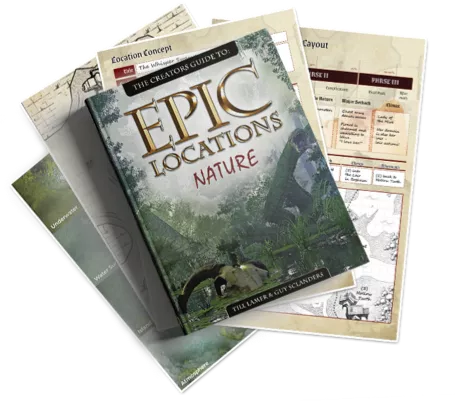
Quick on the fly reference tables and step-by-step creation tips, tricks and guides for every type of natural location imaginable!